North Carolina FHA Refinance, Help Today
Your North Carolina mortgage rate may be higher than today's market. An FHA refinance can lower it. The streamline path is fast, light on paperwork, and built around saving money for North Carolina owners.

Guidance homeowners rely on
When it comes to decisions this important, most homeowners look for signals they can trust. Thousands of families just like yours have moved forward with clarity and confidence through guidance grounded in transparency, precision, and consistent results, reinforced by a strong reputation across trusted platforms throughout the web.




Why North Carolina FHA Refinance Works
FHA refinance program offerings include three structurally distinct paths. A North Carolina FHA streamline reduces rate with minimal paperwork. A North Carolina FHA cash-out unlocks equity to 80% LTV. A North Carolina FHA conv-conversion brings conventional loans into FHA backing.
Our Rates For You
FHA 30 Year Refi
Rates and APR shown are based on a $350,000 loan amount, 850 credit score, primary residence, single family home, 75% loan to value ratio, and owner occupied property. Payment example assumes no other liens on the property and includes principal and interest only. Taxes, insurance, mortgage insurance, and escrow items are not included and will increase the actual payment. Rates, APR, and points are subject to change without notice and may vary based on credit profile, property type, occupancy, loan to value, loan amount, and other qualifying factors. Not all borrowers will qualify.
How North Carolina FHA Refinance Works
Cut North Carolina Monthly Costs
Reducing your North Carolina mortgage rate is the cleanest way to reduce your monthly payment. An FHA refinance, particularly the streamline path for existing FHA owners, captures rate cuts efficiently with minimal paperwork and a fast North Carolina closing timeline.
Access North Carolina Equity
A North Carolina FHA cash-out refinance unlocks up to 80% of your North Carolina home value as liquid cash. Working North Carolina homeowners use the funds for renovations, debt consolidation, college tuition, business investment, or other major life expenses periodically across North Carolina ownership.
Switch North Carolina to Fixed
Credit standards on an FHA refinance are explicitly more forgiving than conventional. The refinance program accepts 580 FICO where conventional usually needs 620-740 for similar pricing terms on refinancing files North Carolina lender networks and county lines.
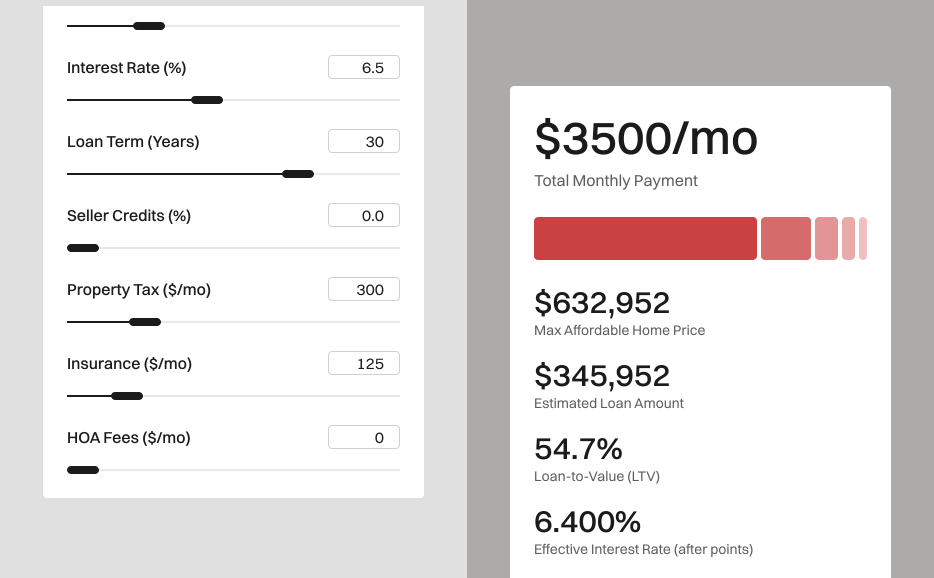
How much could refinancing save you
Enter your current balance, your estimated value, and your target term. The calculator shows a clear estimate that helps you decide if now is the right time.
Begin North Carolina FHA Refinance

Take the FHA refinance first step with us today. Real numbers, plain language, no pressure. We walk through the program and your specific situation in honest detail.
Better mortgage terms on your North Carolina home start with an FHA refinance walkthrough. The conversation is clear, the numbers are real, and the decision stays yours.

Fast Track North Carolina Refinance
The North Carolina FHA streamline refinance keeps rate-reduction refinancing reachable for North Carolina homeowners with existing FHA loans. Minimal paperwork. Often no appraisal. North Carolina closings within 21-30 days from streamline file kickoff. Federal program structure makes the streamline consistently accessible.
Access Cash With North Carolina Refi
Cash-out on an FHA refinance unlocks North Carolina home equity for major expenses. Renovations. Debt consolidation. Education costs. Business investments. The funds go to the North Carolina owner; the new mortgage absorbs the cash-out into one consolidated monthly payment.

Real people. Real challenges. Real mortgage success.
FHA Refinance Questions - Need to Know
Still unsure? Talk to someone who hears you, not a script.
A North Carolina FHA refinance works by paying off your current mortgage with a new FHA-insured loan. Application, credit pull, appraisal (often skipped on streamlines), and underwriting follow the standard 30-45 day North Carolina timeline. The federal MIP structure replaces your old mortgage insurance and keeps the lender risk manageable.
An FHA refinance is available to North Carolina homeowners with existing FHA loans (streamline path) or conventional loans (conv-to-FHA conversion). Credit acceptance starts at 580 FICO. The home must be the North Carolina primary residence. Income, employment, and DTI all factor into qualification.
The difference between North Carolina FHA streamline and cash-out is significant. The streamline is a low-doc, no-appraisal, FHA-to-FHA rate reduction. The cash-out is a full-doc refi (any starting loan type) that taps home equity. Streamline closes in 21-30 days; cash-out runs the standard 30-45 day North Carolina timeline.
An FHA refinance can lower your monthly payment when current rates are below your existing rate. North Carolina homeowners typically save $100-300 monthly when the rate gap reaches 0.5%+, with the streamline path capturing savings most efficiently for existing FHA borrowers.
Income verification on the North Carolina FHA streamline refinance is typically waived. A North Carolina streamline borrower with an existing FHA loan in good standing (12+ months of on-time payments) usually doesn't need to provide paystubs, W-2s, or employment verification, which speeds the North Carolina file dramatically.
Equity requirements on an FHA refinance depend on the path. Streamline requires no equity (and supports underwater North Carolina loans). Cash-out requires retaining at least 20% equity post-refinance (80% LTV maximum). Conv-to-Refi generally requires positive equity for the new North Carolina mortgage to fit FHA limits.
Yes, an FHA refinance supports underwater North Carolina loans through the streamline program. The streamline doesn't require an appraisal in most cases, which means North Carolina owners with negative equity can still capture rate-reduction savings without the appraisal blocking the file. Cash-out requires positive equity.
Explore other refinance options






The latest from Oxford




Still have a question?
No problem. Let’s just talk.


About Oxford
Refinance Loan
Resources & Calculators
Hire
Advertised offers are not guaranteed if you do not continue to meet Oxford Home Lending's criteria and other factors bearing on your creditworthiness. Rates will vary depending on your loan term, loan type, credit profile & score, down payment, qualifying ratios, and property collateral. Monthly payments do not include property taxes, property insurance, and homeowners' association dues. Since costs can vary based on a loan program, closing costs are not shown in the examples. To qualify for a mortgage, borrowers must be U.S. citizens or permanent residents, and meet Oxford Home Lending's underwriting and Investor requirements. Interest rate examples are as of 03/03/2026 and subject to change without notice. All loans are subject to underwriting or investor approval. Other restrictions may apply. This is not an offer of credit or a commitment to lend. Rate subject to change depending on time of lock.
Lower, LLC DBA Oxford Home Lending | NMLS #1124061 | www.nmlsconsumeraccess.com.
Lower, LLC | NMLS ID# 1124061 | 5950 Symphony Woods Road Suite 312 Columbia, MD 21044 | Equal Housing Opportunity | https://nmlsconsumeraccess.org/ | Not an offer of credit or commitment to make a loan; all approvals are subject to underwriting guidelines including but not limited to acceptable current credit worthiness, income history, debt ratio, etc. Loan programs & options are subject to change at any time. Rates will vary depending on your loan term, loan type, credit profile, down payment, and qualifying ratios. Rates can change daily. Some restrictions may apply. No statement herein should be construed as being made on behalf of any state or federal agency.
© 2026 Lower, LLC | Conducts business in 47 States to include the District of Columbia. Alabama, Alaska, Arizona - License #1000936, Arkansas, California, Colorado, Connecticut, Delaware, District of Columbia, Florida, Georgia, Idaho, Illinois, Indiana, Iowa, Kansas, Kentucky (Lower.com, LLC), Louisiana, Maine, Maryland, Massachusetts Mortgage Broker License -- MC1124061 | Massachusetts Mortgage Lender License -- MC1124061, Michigan, Minnesota, Mississippi, Missouri, Montana (Lower.com, LLC), Nebraska, New Hampshire, New Jersey, New Mexico, Nevada, North Carolina, North Dakota, Ohio, Oklahoma (Lower Mortgage, LLC), Oregon, Pennsylvania, Rhode Island, South Carolina, South Dakota, Tennessee, Texas, Utah, Virginia, Washington (Lower.com, LLC), West Virginia, Wisconsin, and Wyoming.
Refinance: By refinancing your existing loan, your total finance charge may be higher over the life of the loan.
Reviews: Zillow® is a trademark of Zillow, Inc. Bankrate® is a trademark of Bankrate, LLC. Lending Tree® is a trademark of Lending Tree, LLC. Google® is a trademark of Google LLC. Facebook® is a trademark of Facebook, Inc.