Connecticut Conventional Loan Engineered to Your File
A Connecticut Conventional Loan done right: 3% down for qualified buyers, honest conforming math, real PMI structure. We run your file before recommending anything - real numbers first.

Guidance homeowners rely on
When it comes to decisions this important, most homeowners look for signals they can trust. Thousands of families just like yours have moved forward with clarity and confidence through guidance grounded in transparency, precision, and consistent results, reinforced by a strong reputation across trusted platforms throughout the web.




Why Conventional Earns the Move in Connecticut
Down Payments as Low as 3 Percent in Connecticut
Conventional 3% is real - qualification matters more than the headline. We tell you upfront whether your file qualifies for 3%, or whether 5-10% is the realistic floor.
Conventional Rates vs FHA in Connecticut
Comparing conventional vs FHA properly means including mortgage insurance. We run all program options against your file rather than defaulting to conventional.
PMI Cancellation Rules for Connecticut Buyers
PMI applies under 20% down but expires at clear thresholds. Auto-cancels at 78% of original value. Earlier removal at 80% current value via appraisal.
Our Rates For You
CONV 30 Year Purchase
Rates and APR shown are based on a $350,000 loan amount, 850 credit score, primary residence, single family home, 75% loan to value ratio, and owner occupied property. Payment example assumes no other liens on the property and includes principal and interest only. Taxes, insurance, mortgage insurance, and escrow items are not included and will increase the actual payment. Rates, APR, and points are subject to change without notice and may vary based on credit profile, property type, occupancy, loan to value, loan amount, and other qualifying factors. Not all borrowers will qualify.
Your Path to a Connecticut Conventional
Three Things a Connecticut Conventional Loan Does Right

Loan Amounts That Cover Most Connecticut Markets
The conforming limit from FHFA caps conventional loan size. Those limits cover most purchase prices in current markets. We tell you upfront whether your target purchase falls within standard conforming territory or stretches into high-balance or jumbo. Conforming application affects rate structure and program eligibility.
Connecticut Fixed vs Adjustable Options
Fixed terms (30, 15) and ARM structures (5/6, 7/6, 10/6) both available. The right choice depends on how long you plan to keep the home. Long-term hold favors fixed; planned move within seven years often favors ARM. We model both before recommending.
Property Type Flexibility on Connecticut Conventional
Conventional financing fits primary, second, or investment property. Each type has different minimum down payment and pricing rules. Primary starts at 3% for qualified buyers; second homes need 10% minimum; investments typically 15-25% with rate adjustments.
$810M
18 Years
27500+
Conventional vs Other Loans
Conventional
FHA
VA
USDA
For homes beyond standard loan limits.
High value homes should not mean high stress financing. A conventional loan with jumbo options offers competitive rates, simple terms, and a clear path to purchase without compromise.

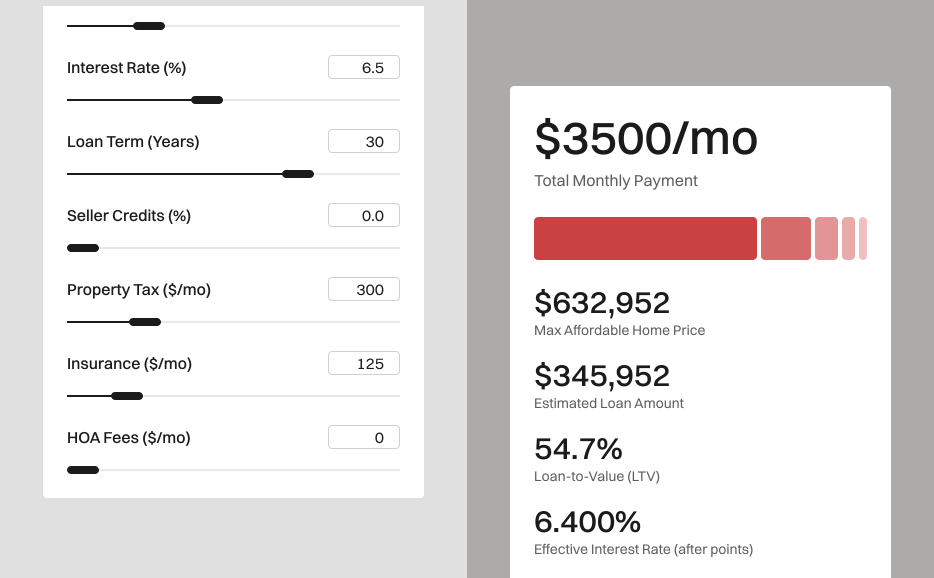
What could you afford with a conventional loan
Before you fall for a listing, see how the math feels. Use the calculator to test price, down payment, and taxes for your county. You will know what is comfortable before you schedule tours.
Real people. Real challenges. Real mortgage success.
What if answers changed everything you feared?
Still unsure? Talk to someone who hears you, not a script.
A Connecticut Conventional Loan is not backed by a government agency. It follows Fannie Mae or Freddie Mac guidelines and is funded by private lenders, with terms based on your credit, down payment, and DTI. Most Connecticut buyers use a 30-year fixed.
Down payment starts at 3% for qualified first-time and repeat buyers. Standard conventional purchases run 5% minimum. Putting 20% down eliminates PMI entirely. We compare the math at 3%, 5%, 10%, and 20% on your file so the decision rests on real numbers.
620 is generally the conventional credit minimum. Some lender overlays push it to 640 or 660. Below 620, FHA tends to fit better. We pull your credit on day one and tell you exactly which programs your score qualifies for.
Automatic cancellation triggers at 78% of original loan-to-value. You can request cancellation at 80% based on current value through a borrower-paid appraisal. Once cancelled, PMI never returns - unlike FHA where mortgage insurance often persists for the loan life.
Fixed = locked rate forever. ARM = lower start, then adjusts. ARM starts lower then adjusts after the initial period (5, 7, or 10 years). Fixed wins long-term plans. ARM saves money if you sell or refinance before the first adjustment.
The 2026 baseline conforming limit is $806,500 for single-family homes. Loans above the standard limit cross into jumbo territory with different underwriting and pricing rules. We confirm your loan size against the limit before quoting.
Conventional handles primary residences, second homes, and investments. Primary starts at 3% down for qualified buyers; second homes need 10% minimum; investments typically need 15-25% with rate adjustments. We map your specific scenario to the right structure before quoting.
The latest from Oxford




Still have a question?
No problem. Let’s just talk.


About Oxford
Refinance Loan
Resources & Calculators
Hire
Advertised offers are not guaranteed if you do not continue to meet Oxford Home Lending's criteria and other factors bearing on your creditworthiness. Rates will vary depending on your loan term, loan type, credit profile & score, down payment, qualifying ratios, and property collateral. Monthly payments do not include property taxes, property insurance, and homeowners' association dues. Since costs can vary based on a loan program, closing costs are not shown in the examples. To qualify for a mortgage, borrowers must be U.S. citizens or permanent residents, and meet Oxford Home Lending's underwriting and Investor requirements. Interest rate examples are as of 03/03/2026 and subject to change without notice. All loans are subject to underwriting or investor approval. Other restrictions may apply. This is not an offer of credit or a commitment to lend. Rate subject to change depending on time of lock.
Lower, LLC DBA Oxford Home Lending | NMLS #1124061 | www.nmlsconsumeraccess.com.
Lower, LLC | NMLS ID# 1124061 | 5950 Symphony Woods Road Suite 312 Columbia, MD 21044 | Equal Housing Opportunity | https://nmlsconsumeraccess.org/ | Not an offer of credit or commitment to make a loan; all approvals are subject to underwriting guidelines including but not limited to acceptable current credit worthiness, income history, debt ratio, etc. Loan programs & options are subject to change at any time. Rates will vary depending on your loan term, loan type, credit profile, down payment, and qualifying ratios. Rates can change daily. Some restrictions may apply. No statement herein should be construed as being made on behalf of any state or federal agency.
© 2026 Lower, LLC | Conducts business in 47 States to include the District of Columbia. Alabama, Alaska, Arizona - License #1000936, Arkansas, California, Colorado, Connecticut, Delaware, District of Columbia, Florida, Georgia, Idaho, Illinois, Indiana, Iowa, Kansas, Kentucky (Lower.com, LLC), Louisiana, Maine, Maryland, Massachusetts Mortgage Broker License -- MC1124061 | Massachusetts Mortgage Lender License -- MC1124061, Michigan, Minnesota, Mississippi, Missouri, Montana (Lower.com, LLC), Nebraska, New Hampshire, New Jersey, New Mexico, Nevada, North Carolina, North Dakota, Ohio, Oklahoma (Lower Mortgage, LLC), Oregon, Pennsylvania, Rhode Island, South Carolina, South Dakota, Tennessee, Texas, Utah, Virginia, Washington (Lower.com, LLC), West Virginia, Wisconsin, and Wyoming.
Refinance: By refinancing your existing loan, your total finance charge may be higher over the life of the loan.
Reviews: Zillow® is a trademark of Zillow, Inc. Bankrate® is a trademark of Bankrate, LLC. Lending Tree® is a trademark of Lending Tree, LLC. Google® is a trademark of Google LLC. Facebook® is a trademark of Facebook, Inc.