Your Connecticut First Time Home Buyer Steps Made Clear
Becoming a first-home buyer is more accessible than most people think. With 3-3.5% down options, down payment assistance, and supportive guidance, you can get into your first home with true support every step.

Guidance first time buyers rely on
When it comes to purchasing a home, buyers look for guidance they can trust. Thousands have moved forward with clarity and confidence through support grounded in transparency, precision, and proven results, reinforced by a strong reputation across trusted platforms throughout the web.



Connecticut First Time Buyers Get Real Answers Here
Your first-home buying journey deserves genuine support throughout. We deliver patient guidance, plain-language explanations, honest answers, and supportive guidance from start to keys. Our first-home buyer process is built around your true needs and actual decisions.
Step One for Connecticut First Time Buyers
A first-home buyer's first move is the baseline step. Supportive conversation, soft credit check (no score impact), new buyer program review, and budget walkthrough combine to put you on the workable path toward first-home keys with backing.

Our Rates For You
VA IRRRL 30 Year Refi
VA 30 Year Refi
Rates and APR shown are based on a $350,000 loan amount, 850 credit score, primary residence, single family home, 75% loan to value ratio, and owner occupied property. Payment example assumes no other liens on the property and includes principal and interest only. Taxes, insurance, mortgage insurance, and escrow items are not included and will increase the actual payment. Rates, APR, and points are subject to change without notice and may vary based on credit profile, property type, occupancy, loan to value, loan amount, and other qualifying factors. Not all borrowers will qualify.
Your Connecticut First Time Home Buyer Process Step One
Real people. Real challenges. Real mortgage success.
Connecticut First Time Home Buyer Step Forward Today

A first-home buyer's first step is the baseline buying power conversation that opens everything next. Know your budget clearly. Understand new buyer programs that fit your situation. Shop with confidence. The first step is supportive, free, supported.
Soft credit pull. Free, supportive, pressure-free. Honest numbers support your true decision.

Worried about the down payment?
Let’s be honest, saving up for a home isn’t easy when rent, groceries, and life keep getting more expensive.
But here’s what most buyers don’t know:
You might already qualify for help.
There are down payment assistance programs, grants, and first-time buyer incentives that could open the door sooner than you think, if you know where to look.
We'll help you find every option available to you, because money shouldn't be the reason you give up on the home you've dreamed of.
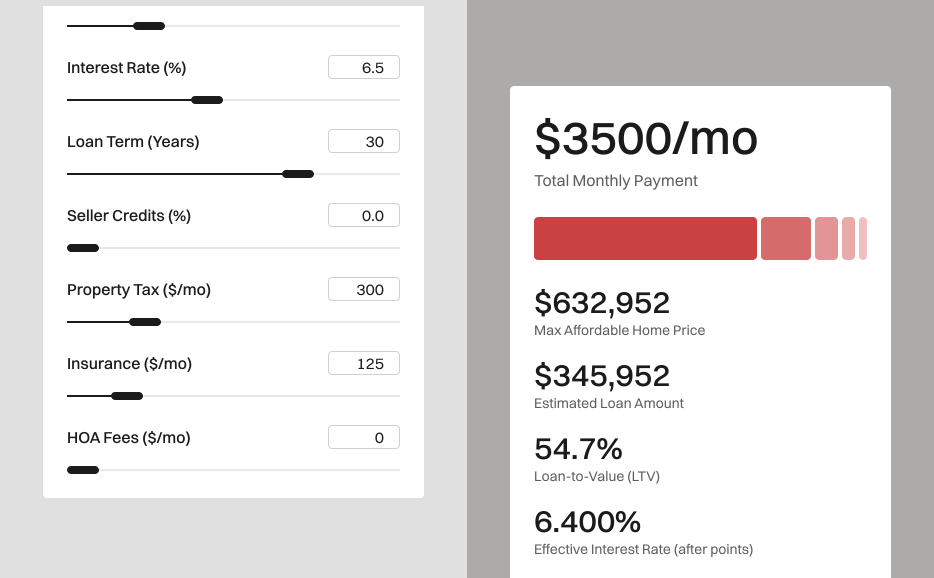
The calculator that tells the truth
This is not about chasing a perfect rate. It is about finding the path that serves you best right now.
What if answers changed everything you feared?
Still unsure? Talk to someone who hears you, not a script.
A Connecticut first time home buyer program makes ownership achievable when 20% down feels out of reach. First-time buyer programs let you purchase with as little as 3% down, often combined with grants or forgivable loans for additional help. The combined savings get you into a home years sooner than waiting to save 20%.
A first-home buyer can put down as little as 3% on a conventional loan or 3.5% on FHA. Eligible veterans and rural buyers may qualify for 0% down through VA or USDA programs. New buyer assistance programs commonly reduce these minimums further with grants or forgivable loans toward down payment.
Yes, condos are eligible for most first-home buyer programs. The condo association must usually meet lender requirements: adequate reserves, low investor concentration, no major litigation. FHA condo loans require properties on the FHA-approved list. New buyers should verify condo eligibility early in their search.
A first-home buyer should expect closing costs of roughly 2-5% of the purchase price. On a typical Connecticut starter home around $250,000, that's $5,000-$12,500 at closing. Closing costs include origination fees, title insurance, appraisal ($400-600), and prepaid taxes and insurance. New buyer programs frequently include closing cost grants.
No, perfect credit isn't required for first-home buyers. The minimum credit score depends on the loan: 580 for FHA, 620 for conventional, lower for VA loans. New buyer programs are usually designed to work with moderate credit (620-680) and stronger compensating factors like steady income and savings.
Yes, having debt doesn't prevent a first-home buyer from buying. Lenders evaluate the debt-to-income ratio (DTI), which includes student loans, car payments, credit cards, and the new mortgage payment. New buyers with DTI under 43-50% usually qualify, even while actively paying off debt. Stronger credit and higher income create more room for debt.
A first-home buyer's best loan depends on situation. Strong credit + 3-5% down: conventional 97. Lower credit + 3.5% down: FHA. Eligible veteran + 0% down: VA loan. Rural Connecticut property + 0% down: USDA loan. Each loan has different rates, mortgage insurance rules, and new buyer assistance compatibility worth comparing.
The latest from Oxford




Still have a question?
No problem. Let’s just talk.


About Oxford
Refinance Loan
Resources & Calculators
Hire
Advertised offers are not guaranteed if you do not continue to meet Oxford Home Lending's criteria and other factors bearing on your creditworthiness. Rates will vary depending on your loan term, loan type, credit profile & score, down payment, qualifying ratios, and property collateral. Monthly payments do not include property taxes, property insurance, and homeowners' association dues. Since costs can vary based on a loan program, closing costs are not shown in the examples. To qualify for a mortgage, borrowers must be U.S. citizens or permanent residents, and meet Oxford Home Lending's underwriting and Investor requirements. Interest rate examples are as of 03/03/2026 and subject to change without notice. All loans are subject to underwriting or investor approval. Other restrictions may apply. This is not an offer of credit or a commitment to lend. Rate subject to change depending on time of lock.
Lower, LLC DBA Oxford Home Lending | NMLS #1124061 | www.nmlsconsumeraccess.com.
Lower, LLC | NMLS ID# 1124061 | 5950 Symphony Woods Road Suite 312 Columbia, MD 21044 | Equal Housing Opportunity | https://nmlsconsumeraccess.org/ | Not an offer of credit or commitment to make a loan; all approvals are subject to underwriting guidelines including but not limited to acceptable current credit worthiness, income history, debt ratio, etc. Loan programs & options are subject to change at any time. Rates will vary depending on your loan term, loan type, credit profile, down payment, and qualifying ratios. Rates can change daily. Some restrictions may apply. No statement herein should be construed as being made on behalf of any state or federal agency.
© 2026 Lower, LLC | Conducts business in 47 States to include the District of Columbia. Alabama, Alaska, Arizona - License #1000936, Arkansas, California, Colorado, Connecticut, Delaware, District of Columbia, Florida, Georgia, Idaho, Illinois, Indiana, Iowa, Kansas, Kentucky (Lower.com, LLC), Louisiana, Maine, Maryland, Massachusetts Mortgage Broker License -- MC1124061 | Massachusetts Mortgage Lender License -- MC1124061, Michigan, Minnesota, Mississippi, Missouri, Montana (Lower.com, LLC), Nebraska, New Hampshire, New Jersey, New Mexico, Nevada, North Carolina, North Dakota, Ohio, Oklahoma (Lower Mortgage, LLC), Oregon, Pennsylvania, Rhode Island, South Carolina, South Dakota, Tennessee, Texas, Utah, Virginia, Washington (Lower.com, LLC), West Virginia, Wisconsin, and Wyoming.
Refinance: By refinancing your existing loan, your total finance charge may be higher over the life of the loan.
Reviews: Zillow® is a trademark of Zillow, Inc. Bankrate® is a trademark of Bankrate, LLC. Lending Tree® is a trademark of Lending Tree, LLC. Google® is a trademark of Google LLC. Facebook® is a trademark of Facebook, Inc.