Illinois HELOC Loans on a Smart Schedule
Illinois HELOC loans give Illinois homeowners on-demand equity access. Draw funds for projects, emergencies, or opportunities. Repay and use again throughout the draw period without reapplying for new loans.

Guidance homeowners rely on
When it comes to accessing your home’s equity, homeowners look for guidance they can trust. Thousands have moved forward with clarity and control through solutions grounded in transparency, precision, and proven results, reinforced by a strong reputation across trusted platforms throughout the web




Reasons to Pick Illinois HELOC Loans
Equity Access Without Waste
An Illinois HELOC loan delivers borrowing flexibility Illinois owners actually use. Draw, repay, redraw without reapplying. Interest only applies to drawn balances, keeping ongoing borrowing costs reasonable.
Pricing That Saves You Money
Illinois HELOC loans deliver lower rates than credit cards or personal loans for Illinois homeowners. Interest accrues only on drawn amounts, keeping ongoing costs minimal across the draw period years.
Interest-Only Payment Window
A revolving credit line delivers payment flexibility for Illinois homeowners. Interest-only minimums during draw period, principal prepayment optional anytime, full flexibility to manage cash flow across years.
Improvement-Use Deduction Possible
Interest on an Illinois HELOC loan used for renovations may qualify as deductible mortgage interest under IRS rules. Illinois homeowners benefit from this potential tax advantage with proper documentation.
Speed for Time-Sensitive Needs
Revolving credit lines deliver fund access on Illinois homeowner schedules. Online portal, debit card swipes, paper checks. Most draws process same-business-day, supporting timely payments across the draw period.
Keep What You Already Have
Revolving credit lines preserve your first mortgage entirely. Illinois homeowners with attractive primary rates benefit from keeping them while accessing additional equity through the flexible Home equity credit line structure.

Compare HELOC loans side by side with other financing options
HELOC
Home Equity Loan
Cash-Out Refinance
Credit Card
If your needs arrive in stages or may repeat, HELOC loans gives you flexibility and control. If you know the exact cost of a one-time project, a home equity loan may appeal. If you want to overhaul your mortgage or remove PMI, a cash-out refi is the better lever. Credit cards are last-resort funding for larger projects due to rate and payoff traps.
Setting Up Your Illinois HELOC Loan
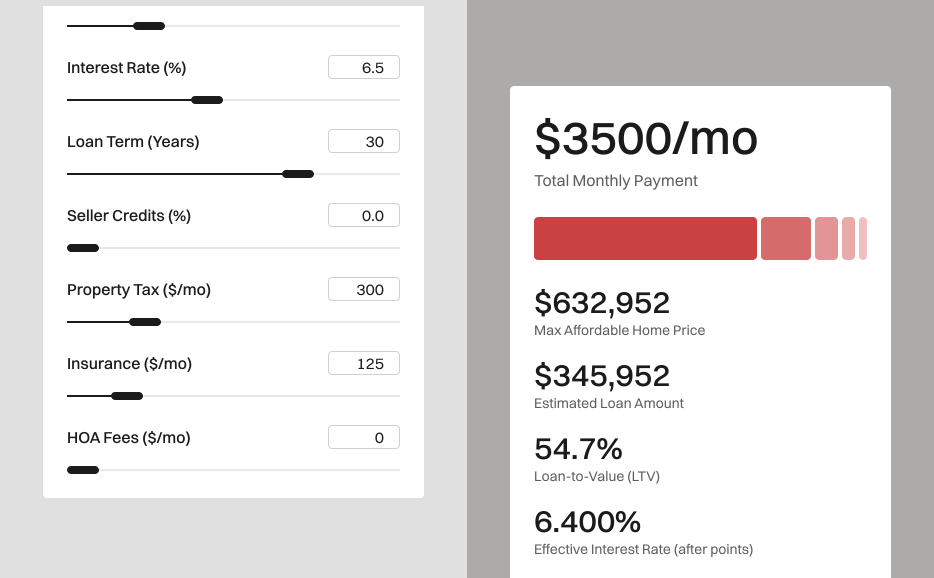
See your available equity before you apply
Estimate available equity in minutes. Enter your home value and what you still owe, then test draw amounts for projects, consolidation, or a safety reserve. You will see a simple monthly estimate, which helps you choose a number that respects your budget.
Real people. Real challenges. Real mortgage success.
Explore other refinance options






What if answers changed everything you feared?
Still unsure? Talk to someone who hears you, not a script.
An Illinois HELOC loan provides Illinois homeowners with a credit line secured by home equity. The structure is revolving: borrow as needed, repay, and reuse the line. Most HELOC loans carry variable rates that adjust with the market and offer interest-only payment options during the draw period.
Revolving credit lines and home equity loans serve different purposes. A HELOC is revolving (draw, repay, reuse), variable-rate, and flexible. A home equity loan is lump-sum, fixed-rate, and predictable. Pick the HELOC when borrowing needs are uncertain; pick the home equity loan when the expense is known and one-time.
A revolving credit line funds the major expenses Illinois homeowners face periodically. Home improvements top the list (interest may be tax-deductible). Debt consolidation comes second (replacing 18-25% credit card APRs with sub-10% HELOC rates). Education, medical, and emergency uses round out typical the home equity credit line applications.
The revolving credit line rates work via a prime-rate-plus-margin formula. Prime moves with the Federal Reserve's federal funds rate. Your margin (typically 0.5-3 percentage points) depends on credit, equity, and lender pricing. Illinois homeowners with the strongest profiles see the narrowest margins; weaker profiles add more margin to the prime base.
Yes, a revolving credit line interest can be tax deductible when funds are used to improve the home that secures the loan. The IRS rule (post-2017 Tax Cuts and Jobs Act) limits HELOC interest deductibility to home-improvement uses. Illinois homeowners should keep records of how funds are spent to support deductions during tax filing.
A revolving credit line suits Illinois homeowners with strong equity, steady income, and flexible borrowing goals. It's especially useful for staged renovations, ongoing debt consolidation, or as a financial safety net. It's less ideal if you prefer fixed payments, want one lump sum, or have unstable income that can't reliably handle variable rates.
Illinois home value changes generally don't affect your existing the revolving credit line limit. The line was approved based on the value at origination, and most Home equity credit lines don't include automatic re-evaluation clauses. Significant market drops can trigger a lender review, but routine appreciation or depreciation typically leaves the credit line untouched.
The latest from Oxford




Still have a question?
No problem. Let’s just talk.


About Oxford
Refinance Loan
Resources & Calculators
Hire
Advertised offers are not guaranteed if you do not continue to meet Oxford Home Lending's criteria and other factors bearing on your creditworthiness. Rates will vary depending on your loan term, loan type, credit profile & score, down payment, qualifying ratios, and property collateral. Monthly payments do not include property taxes, property insurance, and homeowners' association dues. Since costs can vary based on a loan program, closing costs are not shown in the examples. To qualify for a mortgage, borrowers must be U.S. citizens or permanent residents, and meet Oxford Home Lending's underwriting and Investor requirements. Interest rate examples are as of 03/03/2026 and subject to change without notice. All loans are subject to underwriting or investor approval. Other restrictions may apply. This is not an offer of credit or a commitment to lend. Rate subject to change depending on time of lock.
Lower, LLC DBA Oxford Home Lending | NMLS #1124061 | www.nmlsconsumeraccess.com.
Lower, LLC | NMLS ID# 1124061 | 5950 Symphony Woods Road Suite 312 Columbia, MD 21044 | Equal Housing Opportunity | https://nmlsconsumeraccess.org/ | Not an offer of credit or commitment to make a loan; all approvals are subject to underwriting guidelines including but not limited to acceptable current credit worthiness, income history, debt ratio, etc. Loan programs & options are subject to change at any time. Rates will vary depending on your loan term, loan type, credit profile, down payment, and qualifying ratios. Rates can change daily. Some restrictions may apply. No statement herein should be construed as being made on behalf of any state or federal agency.
© 2026 Lower, LLC | Conducts business in 47 States to include the District of Columbia. Alabama, Alaska, Arizona - License #1000936, Arkansas, California, Colorado, Connecticut, Delaware, District of Columbia, Florida, Georgia, Idaho, Illinois, Indiana, Iowa, Kansas, Kentucky (Lower.com, LLC), Louisiana, Maine, Maryland, Massachusetts Mortgage Broker License -- MC1124061 | Massachusetts Mortgage Lender License -- MC1124061, Michigan, Minnesota, Mississippi, Missouri, Montana (Lower.com, LLC), Nebraska, New Hampshire, New Jersey, New Mexico, Nevada, North Carolina, North Dakota, Ohio, Oklahoma (Lower Mortgage, LLC), Oregon, Pennsylvania, Rhode Island, South Carolina, South Dakota, Tennessee, Texas, Utah, Virginia, Washington (Lower.com, LLC), West Virginia, Wisconsin, and Wyoming.
Refinance: By refinancing your existing loan, your total finance charge may be higher over the life of the loan.
Reviews: Zillow® is a trademark of Zillow, Inc. Bankrate® is a trademark of Bankrate, LLC. Lending Tree® is a trademark of Lending Tree, LLC. Google® is a trademark of Google LLC. Facebook® is a trademark of Facebook, Inc.