Michigan HELOC Loans for Real Flexibility
Michigan HELOC loans put your equity within reach for Michigan owners. Variable rates, draw on demand, repay flexibly, and reuse the line for ongoing or unexpected expenses throughout the draw period.

Guidance homeowners rely on
When it comes to accessing your home’s equity, homeowners look for guidance they can trust. Thousands have moved forward with clarity and control through solutions grounded in transparency, precision, and proven results, reinforced by a strong reputation across trusted platforms throughout the web



Michigan HELOC Loan Highlights
Tap What You Use, Skip the Rest in Michigan
A Michigan HELOC loan gives Michigan homeowners borrowing on their terms. Use the line for projects, emergencies, debt consolidation. Interest only applies to drawn amounts, never the full credit line.
Lower Cost Than Plastic in Michigan
Michigan HELOC loan rates are typically lower than credit cards, personal loans, or unsecured borrowing. Michigan homeowners benefit from secured borrowing rates that compound savings across the draw period years.
Payment Flexibility When Needed in Michigan
Michigan homeowners with a credit line benefit from flexible payment structure. Interest-only during draw period, optional principal payments anytime, and full revolving access across years of homeownership.
Possible IRS-Approved Deductions in Michigan
Michigan HELOC loan interest is potentially deductible when funds buy, build, or substantially improve the home that secures the loan. Michigan homeowners should consult a tax professional to confirm eligibility.
Easy Access to Your Equity in Michigan
Your credit line delivers fund access without delay across the draw period. Online portal, debit card, paper checks. Michigan homeowners typically receive funds same-business-day for routine amounts.
First Mortgage Untouched in Michigan
Your credit line operates separately from your first mortgage. Michigan homeowners keep their primary rate, balance, and term unchanged while gaining flexible credit access for ongoing or major borrowing.

Compare HELOC loans side by side with other financing options
HELOC
Home Equity Loan
Cash-Out Refinance
Credit Card
If your needs arrive in stages or may repeat, HELOC loans gives you flexibility and control. If you know the exact cost of a one-time project, a home equity loan may appeal. If you want to overhaul your mortgage or remove PMI, a cash-out refi is the better lever. Credit cards are last-resort funding for larger projects due to rate and payoff traps.
Steps to Your Michigan HELOC Loan
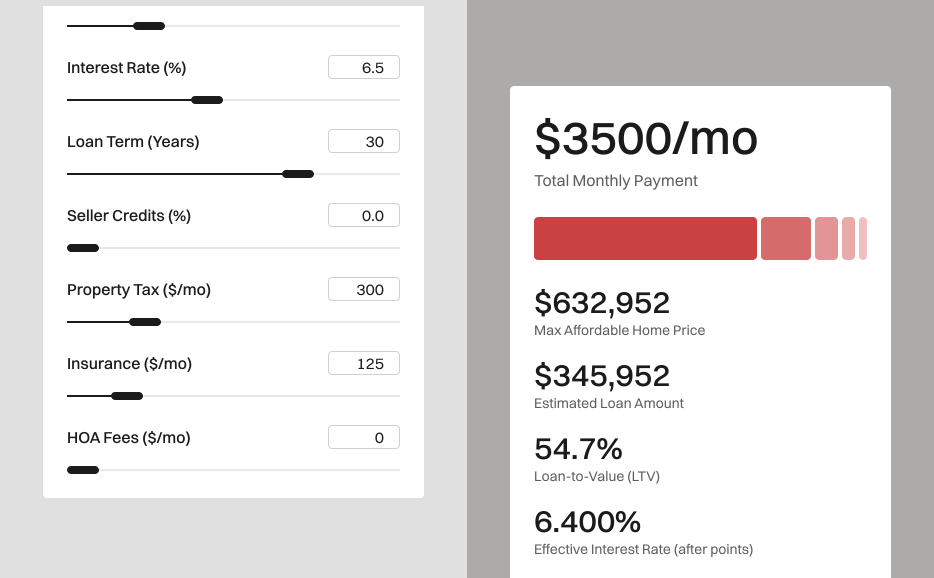
See your available equity before you apply
Estimate available equity in minutes. Enter your home value and what you still owe, then test draw amounts for projects, consolidation, or a safety reserve. You will see a simple monthly estimate, which helps you choose a number that respects your budget.
Real people. Real challenges. Real mortgage success.
Explore other refinance options






What if answers changed everything you feared?
Still unsure? Talk to someone who hears you, not a script.
A Michigan HELOC loan offers flexibility that fixed loans don't match. Michigan homeowners pick a HELOC loan when they want ongoing access to funds rather than a single lump sum. The revolving structure works well for staged projects, surprise expenses, or when borrowing needs are uncertain over time.
A credit line is a good idea when you have substantial home equity, stable income, and flexible borrowing needs. Michigan homeowners benefit most when projects come in stages, when emergencies might arise, or when consolidating high-interest debt. It's less ideal for borrowers wanting fixed payments or single one-time expenses.
A credit line and cash-out refinance differ in structure and impact on your first mortgage. The equity line is a second-lien credit line on top of your existing mortgage. Cash-out refinance replaces your first mortgage with a new, larger loan. Pick HELOC to keep your current mortgage rate; pick cash-out to consolidate.
Yes, a credit line is available shortly after buying your Michigan home, though most lenders prefer 6-12 months of payment history first. Michigan homeowners with substantial down payments (20%+) typically have enough equity built in from purchase to qualify even within the first year of ownership.
Documents needed for a credit line typically include: 2 years of W-2s, 2 most recent paystubs, 2 months of bank statements, current mortgage statement, homeowners insurance policy, government photo ID, and 2 years of tax returns (for self-employed Michigan borrowers). The lender may also order an appraisal or AVM.
A credit line typically closes in 30-45 days from application. The timeline includes credit pull, income and asset verification, property appraisal (or AVM), title search, and final underwriting. Michigan homeowners with complete documentation and clean credit profiles can sometimes close faster, occasionally within 2-3 weeks of starting the application.
Yes, a Michigan owner can have both a credit line and a home equity loan simultaneously, provided combined borrowing stays within the lender's CLTV cap (typically 80-90%). Michigan homeowners might use a home equity loan for one large planned expense and an equity line for ongoing flexibility, capturing both fixed-rate predictability and revolving access.
The latest from Oxford




Still have a question?
No problem. Let’s just talk.


About Oxford
Refinance Loan
Resources & Calculators
Hire
Advertised offers are not guaranteed if you do not continue to meet Oxford Home Lending's criteria and other factors bearing on your creditworthiness. Rates will vary depending on your loan term, loan type, credit profile & score, down payment, qualifying ratios, and property collateral. Monthly payments do not include property taxes, property insurance, and homeowners' association dues. Since costs can vary based on a loan program, closing costs are not shown in the examples. To qualify for a mortgage, borrowers must be U.S. citizens or permanent residents, and meet Oxford Home Lending's underwriting and Investor requirements. Interest rate examples are as of 03/03/2026 and subject to change without notice. All loans are subject to underwriting or investor approval. Other restrictions may apply. This is not an offer of credit or a commitment to lend. Rate subject to change depending on time of lock.
Lower, LLC DBA Oxford Home Lending | NMLS #1124061 | www.nmlsconsumeraccess.com.
Lower, LLC | NMLS ID# 1124061 | 5950 Symphony Woods Road Suite 312 Columbia, MD 21044 | Equal Housing Opportunity | https://nmlsconsumeraccess.org/ | Not an offer of credit or commitment to make a loan; all approvals are subject to underwriting guidelines including but not limited to acceptable current credit worthiness, income history, debt ratio, etc. Loan programs & options are subject to change at any time. Rates will vary depending on your loan term, loan type, credit profile, down payment, and qualifying ratios. Rates can change daily. Some restrictions may apply. No statement herein should be construed as being made on behalf of any state or federal agency.
© 2026 Lower, LLC | Conducts business in 47 States to include the District of Columbia. Alabama, Alaska, Arizona - License #1000936, Arkansas, California, Colorado, Connecticut, Delaware, District of Columbia, Florida, Georgia, Idaho, Illinois, Indiana, Iowa, Kansas, Kentucky (Lower.com, LLC), Louisiana, Maine, Maryland, Massachusetts Mortgage Broker License -- MC1124061 | Massachusetts Mortgage Lender License -- MC1124061, Michigan, Minnesota, Mississippi, Missouri, Montana (Lower.com, LLC), Nebraska, New Hampshire, New Jersey, New Mexico, Nevada, North Carolina, North Dakota, Ohio, Oklahoma (Lower Mortgage, LLC), Oregon, Pennsylvania, Rhode Island, South Carolina, South Dakota, Tennessee, Texas, Utah, Virginia, Washington (Lower.com, LLC), West Virginia, Wisconsin, and Wyoming.
Refinance: By refinancing your existing loan, your total finance charge may be higher over the life of the loan.
Reviews: Zillow® is a trademark of Zillow, Inc. Bankrate® is a trademark of Bankrate, LLC. Lending Tree® is a trademark of Lending Tree, LLC. Google® is a trademark of Google LLC. Facebook® is a trademark of Facebook, Inc.